

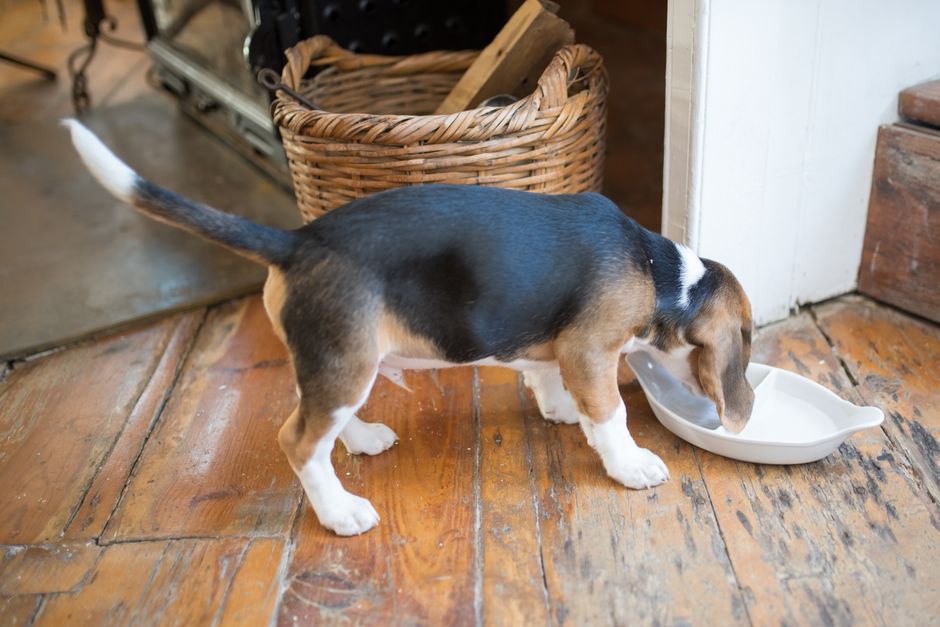
Because that is, mostly, how dogs eat. A dog who empties the bowl in forty seconds flat is being a normal opportunist — dogs come from scavengers, and a scavenger who lingers doesn’t get much. If yours has hoovered their dinner since day one, that alone is rarely a sign anything is wrong.
What matters is whether the speed is new, and whether it’s causing a problem you can see: a pile of undigested kibble on the floor, a waistline heading the wrong way, or a big deep-chested dog where mealtime habits deserve more care.
Start here
If your dog’s appetite has changed, that’s a vet question, not a bowl question. Suddenly ravenous when they never used to be — especially with more drinking, more weeing, weight loss, a pot-bellied look or low energy — needs checking rather than a new dish. The PDSA list excessive hunger among the signs of Cushing’s disease, and it can be a side effect of medication such as steroids. Their advice: contact your vet even if your dog seems otherwise well.
A dog who has always eaten quickly and is otherwise thriving is a different story. The rest of this is for them.
Why dogs eat so fast: five common reasons
It’s simply normal. Eating quickly is ordinary dog behaviour, not a fault to correct. You’d know it’s this if: they’ve always done it, they’re a healthy weight, and nothing has changed.
Competition, real or remembered. Dogs eating alongside another dog speed up, and dogs raised in a litter or through rescue kennels may have learned that hesitating costs them dinner. The PDSA advise separating dogs at mealtimes. You’d know it’s this if: the speed climbs when another dog is in the room.
Some dogs are wired hungrier. Cambridge researchers found a deletion in the POMC gene in Labradors, at an allele frequency of 12%, associated with body weight and greater food motivation — and among other breeds tested, only in the closely related flat-coated retriever. So if your Labrador is permanently, cheerfully starving, you’re not imagining it. You’d know it’s this if: you own a Labrador or a flat-coat, and they have always eaten fast!
They might not be getting enough. Feeding guides on the bag are a starting point, not a prescription. The PDSA advise measuring food carefully, and your vet or vet nurse can help you work out the right amount. You’d know it’s this if: they’re lean and hunting for food between meals.
Dinner is the best thing that happens all day. For a dog whose day is one lead walk and one bowl, food is the entire entertainment budget. The same restlessness usually shows up elsewhere — see why does my dog chew everything. 🐾 You’d know it’s this if: the bowl goes in seconds and they’re straight back to you for the next thing.
What we’d reach for
Two different jobs here, and it’s worth knowing which one you’re solving.
Same meal, eaten more slowly — that’s a bowl. The Rosewood Anti Scoff Slow Feeder is the straightforward one: three raised columns, non-skid base, dishwasher safe. If your dog finds obstacles annoying, the Slodog Slow Feeder spreads dinner across a plate with a much larger surface area instead of making them try to reach it.
The meal becomes the activity — that’s a feeder toy. The KONG Wobbler holds a full meal and works as an alternative to a dog bowl; it unscrews for filling and is dishwasher safe. The KONG Bamboo Feeder Ball twists open for kibble and is made for slow eating at mealtimes.
Is it bad if my dog eats too fast?
Usually not in itself — but three things are worth knowing.
The undigested pile on the floor. The PDSA separate two things owners lump together: vomiting involves nausea and retching, while regurgitation brings up undigested food with no retching or signs of feeling sick, and "usually happens quite soon after eating, and as a one-off can simply mean your dog has eaten too fast". So the heap of barely-touched kibble after dinner is usually speed, not illness.
Bloat, honestly. Gastric dilatation-volvulus is when the stomach fills with gas and twists, cutting off its own blood supply. It moves fast, and the PDSA note approximately 15% of dogs don’t survive it even with treatment. It’s also uncommon and overwhelmingly a big-dog problem: in a UK study of emergency cases, dogs over 40kg had 148.7x the odds of dogs under 10kg. A large study of giant and large breeds did find faster eating among the factors associated with raised GDV risk — but that’s an association, in big dogs, and other papers haven’t found the link at all. It isn’t evidence that slowing your spaniel down protects them, and we’d rather say so than sell you a bowl on it.
Weight. The PDSA estimate nearly half of UK dogs are overweight. Speed doesn’t add calories — portions do — though owners in a Veterinary Record survey did associate certain feeding methods with less hunger and begging. That’s owners’ impressions, not a measured effect in dogs.

How to slow your dog down at mealtimes
Do slow feeder bowls work?
Yes, measurably — in the one study we could find that properly tested them, though it’s a small one. Harper Adams researchers tested ten pet dogs over nine days per feeder type: dogs took significantly longer to finish from a go-slow feeder than a standard bowl, at a significantly lower rate.
Two caveats came with it. Dogs get better at them — by day nine they were quicker than on day one, though still slower than at an ordinary bowl. And the dogs preferred the plain bowl, given a straight choice. The authors caution against conflating slower eating with the dog having fun, and so would we: a slow feeder is a management tool, not a treat.
If your dog seems stressed rather than occupied by a maze bowl, that’s worth listening to.
Make dinner the activity instead
KONGs, chews and activity toys were the most popular forms of enrichment feeding in that Veterinary Record survey, with mental stimulation the most commonly reported benefit.
The KONG Wobbler is the one we suggest most, because it takes a whole meal rather than a handful. The KONG Gyro is an interactive treat dispenser that takes kibble and is designed for independent play. For anything spreadable, a Lickimat holds wet food or pâté in its textured surface. The KONG Classic is the natural rubber standby — stuff it with kibble and freeze it to make it last, and it’s built to be chewed, which softer options aren’t.
One warning on stuffing. If you use peanut butter, read the label. The PDSA describe xylitol as a sugar substitute that is extremely harmful to dogs and can be fatal, and it appears in some nut butters — sometimes listed as "birch sugar".
The free things, and the boring bits
Scatter feeding costs nothing, and the PDSA list it for dogs that eat very quickly. Dogs Trust suggest scattering food around the house or garden and letting your dog search it out. Their test for whether it’s pitched right: are they engaged, enjoying it, or confused and frustrated? If it’s too hard, make it easier.
- Split the day’s food into several smaller meals — PDSA advice for reducing GDV risk.
- Feed from the floor. This one has reversed: the PDSA are explicit that raised bowls were once recommended for at-risk dogs, "but this has now been shown to increase the risk of a GDV".
- Feed dogs separately, and leave an hour either side of meals before exercise.
- Take enrichment food out of the daily ration, not on top of it — Battersea and Dogs Trust agree.
- Supervise puzzle toys, and speak to a qualified behaviourist first if your dog gets possessive around food.
Bring your dog’s weight and what you’re feeding into the shop and we’ll work through it with you — a slow feeder is often not the thing that actually needed changing.
Common questions
Is it bad if my dog eats too fast?
Usually not in itself. Act on it if they regularly bring food back up, if they’re overweight, or if they’re a large or giant deep-chested breed, where eating speed is one of several factors associated with a raised risk of bloat. A sudden change in how your dog eats warrants a vet check.
Do slow feeder bowls actually work?
Yes. A Harper Adams study found dogs took significantly longer to finish a meal from a go-slow feeder than a standard bowl. It was small — ten dogs — with two caveats: dogs got quicker with practice, though still slower than at a normal bowl, and given the choice they preferred the plain bowl. Treat it as a management tool, not something your dog will enjoy.
Why does my dog throw up straight after eating?
If there’s no retching and the food comes back undigested, that’s regurgitation rather than vomiting, and the PDSA say a one-off soon after eating can simply mean your dog ate too fast. If it keeps happening, book an appointment. Continuous retching with a bloated tummy is an emergency.
Can eating too fast cause bloat in dogs?
It’s associated with it in large and giant breeds, and the evidence isn’t settled. One large study found faster eating among the factors linked to GDV risk; others haven’t, and none has shown that slowing a dog down prevents it. Bloat tracks size and breed far more than manners — dogs over 40kg had 148.7 times the odds of dogs under 10kg in a UK study.
How do I slow my dog down at mealtimes?
A slow feeder bowl is the simplest change. Beyond that: scatter the food, put the meal in a treat-dispensing toy, spread wet food on a lick mat, split the ration across more meals, and feed dogs separately. Anything used for games should come out of the day’s food, not on top of it.
Should I worry if my dog is always hungry?
If they’ve always been like it and they’re a healthy weight, no. If the hunger is new, or comes with more drinking, more weeing, weight change, a pot-bellied appearance or low energy, speak to your vet — excessive hunger is among the signs the PDSA list for Cushing’s disease, and it can be a side effect of medication such as steroids.

Sources and further reading
- PDSA — GDV (bloat) in dogs
- PDSA — Vomiting in dogs
- PDSA — Cushing’s Disease in dogs
- PDSA — Obesity in dogs
- PDSA — Poisons and hazards for your pets
- Dogs Trust — Enrichment activities for dogs
- Battersea — Brain games for dogs
- RVC VetCompass — Gastric bloat: 80% survival of surgical cases (O’Neill et al., 2017)
- Glickman et al. — Non-dietary risk factors for gastric dilatation-volvulus, JAVMA, 2000
- Buckley & Lees — Go slow feeding bowls: how effective are they?, Veterinary Evidence, 2016
- Heys, Lloyd & Westgarth — ’Bowls are boring’: enrichment feeding for pet dogs, Veterinary Record, 2024
- Raffan et al. — A deletion in the canine POMC gene, Cell Metabolism, 2016